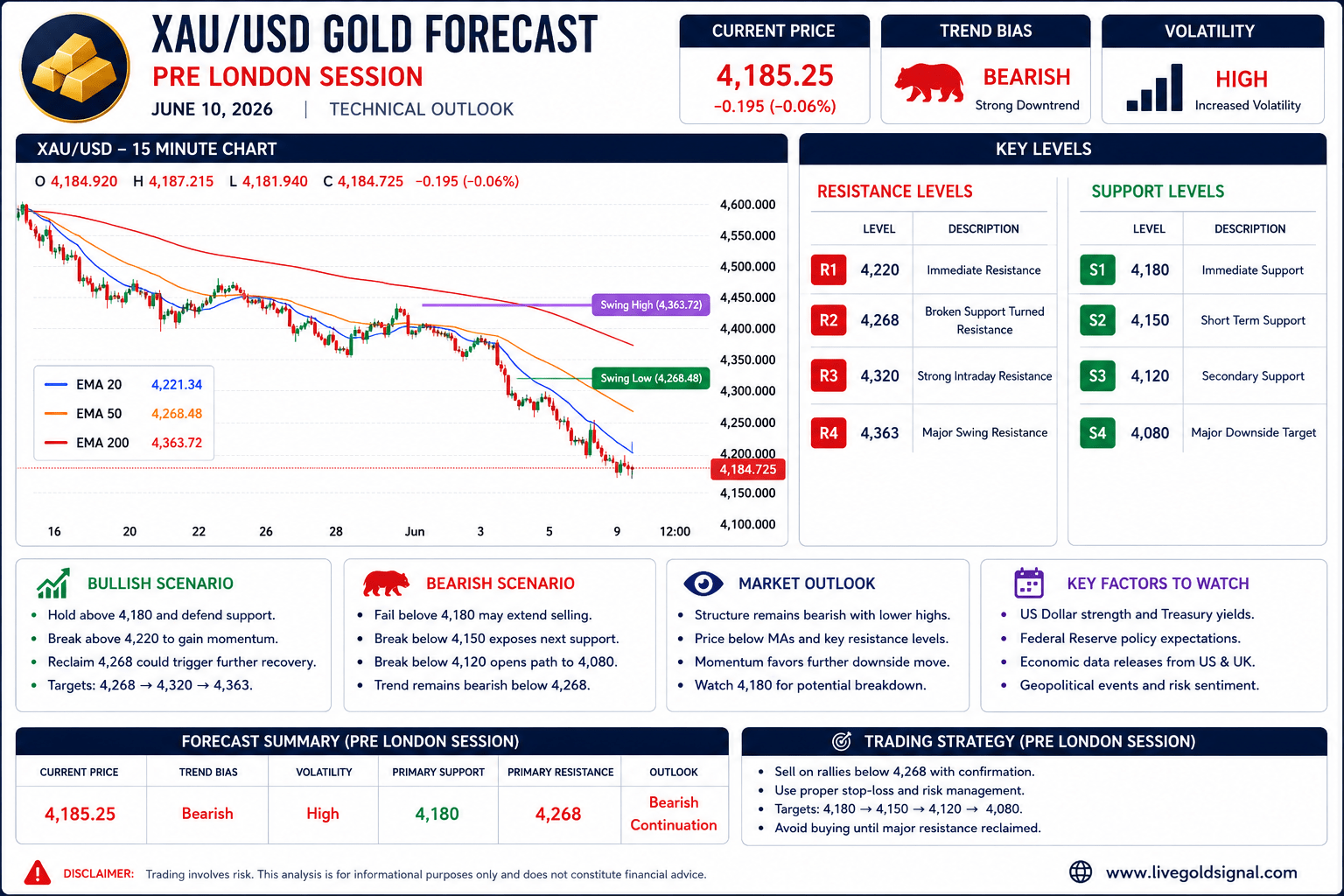
Gold (XAU/USD) remains under strong bearish pressure ahead of the London session as sellers continue to dominate short term market structure. Based on the latest 15-minute chart, gold is currently trading near the 4,185 area after suffering a significant breakdown below several important support levels. The latest decline confirms that bearish momentum remains firmly in control while buyers continue struggling to establish any meaningful recovery.
The recent selloff accelerated after price failed to hold above the previous swing support zone around 4,268. Once that level was broken, market sentiment shifted aggressively toward the downside and triggered a sharp liquidation move. Current price action suggests that institutional selling pressure remains active and that rallies may continue to attract fresh sellers during the London trading session.
Current Market Structure
The overall market structure remains decisively bearish. The chart clearly shows a sequence of lower highs and lower lows that has been developing over the past several trading sessions. Every recovery attempt has been rejected by sellers, confirming that bearish momentum remains dominant.
The previous swing high around 4,363 acted as a major resistance zone where sellers entered aggressively. Following the rejection from that area, price moved lower and eventually broke beneath the critical swing low near 4,268. This breakdown significantly weakened the market structure and opened the door for additional downside movement.
A particularly important observation is that the breakdown occurred with strong momentum rather than a gradual decline. Such aggressive price action often reflects institutional participation and can indicate that larger market participants are positioning for further downside movement.
Currently, gold remains well below the broken support zone. Unless buyers manage to reclaim previous support levels, the bearish trend is likely to remain intact throughout the London session.
Moving Average Analysis
The moving average structure strongly favors sellers. Short term exponential moving averages remain below medium term moving averages, while both continue trading beneath longer term trend indicators. This alignment represents a classic bearish moving average configuration.
Price remains significantly below the major moving average cluster, confirming that downward momentum remains dominant. The distance between current price and major moving averages also highlights the strength of recent selling pressure.
In trending markets, moving averages often act as dynamic resistance zones. Therefore, any corrective recovery toward the EMA cluster may attract additional selling interest. Traders should closely monitor reactions around moving average resistance levels throughout the London session.
Unless price can establish sustained trading above short term moving averages and eventually reclaim medium term trend indicators, the broader technical picture continues to support bearish continuation.
Momentum Analysis
Momentum conditions remain heavily bearish following the latest breakdown. The speed and magnitude of the decline indicate that sellers remain highly aggressive. Strong downside momentum often persists longer than many traders anticipate, particularly after significant support levels are broken.
Although short term oversold conditions may trigger temporary rebounds, these recoveries are likely to remain corrective rather than trend changing. Buyers need considerably stronger momentum before any sustainable recovery can develop.
The current market environment favors momentum continuation strategies rather than aggressive countertrend buying. As long as bearish momentum remains active, downside risks continue to outweigh upside opportunities.
London Session Outlook
The London session is traditionally one of the most active trading periods for gold due to increased liquidity and institutional participation. Given the current bearish structure, traders should prepare for elevated volatility and potential continuation of the existing downtrend.
If sellers maintain control during the opening hours of the London session, gold could extend losses toward deeper support levels. However, increased volatility may also generate temporary corrective rebounds before the primary trend resumes.
The key question for today’s London session is whether buyers can defend current price levels and generate a meaningful recovery. At the moment, technical evidence suggests that sellers maintain a significant advantage.
Key Resistance Levels
| Resistance Level | Description |
|---|---|
| 4,220 | Immediate Resistance |
| 4,268 | Broken Swing Support Turned Resistance |
| 4,320 | Strong Intraday Resistance |
| 4,363 | Major Swing Resistance |
Key Support Levels
| Support Level | Description |
|---|---|
| 4,180 | Immediate Support |
| 4,150 | Short Term Support |
| 4,120 | Secondary Support |
| 4,080 | Major Downside Objective |
Bullish Scenario
For a bullish recovery scenario to develop, buyers must first stabilize price above the 4,180 support region and prevent additional breakdowns. A recovery above 4,220 would provide the first indication that selling pressure is beginning to weaken.
If buyers successfully reclaim 4,268, market sentiment could improve significantly. Such a move would invalidate part of the recent bearish breakdown and potentially encourage additional buying activity.
Under a bullish scenario, upside targets would initially include 4,268, followed by 4,320 and eventually the major resistance zone near 4,363. However, given the current market structure, this remains the secondary scenario.
Bearish Scenario
The bearish scenario remains the primary outlook heading into the London session. As long as gold remains below 4,268, sellers are expected to maintain control of the market.
Any recovery toward resistance zones may attract fresh selling pressure. If gold breaks below 4,180 support, the next downside targets become 4,150 and 4,120. A continuation of current momentum could eventually expose the major downside objective near 4,080.
The combination of lower highs, lower lows, bearish moving average alignment, and strong downside momentum continues to support the bearish continuation outlook.
Market Sentiment Analysis
Market sentiment currently favors defensive positioning. The aggressive breakdown below previous support zones has damaged buyer confidence and increased bearish expectations across short term timeframes.
Professional traders often focus on whether broken support levels can be reclaimed. Until that occurs, market psychology generally remains negative. This environment often encourages traders to view rallies as selling opportunities rather than buying opportunities.
The sharp decline visible on the chart suggests that market participants are actively reducing long exposure while increasing bearish positioning. Such sentiment conditions often reinforce existing trends.
Fundamental Factors To Watch
Several important fundamental catalysts could influence gold during today’s London session. Traders should closely monitor US Dollar strength, Treasury yield movements, Federal Reserve policy expectations, inflation outlook, and broader market sentiment.
A stronger US Dollar generally creates additional pressure on gold prices. Rising Treasury yields may also reduce the attractiveness of non-yielding assets such as gold. Conversely, weaker economic data or increased geopolitical uncertainty could provide temporary support.
Market participants should remain alert for unexpected news headlines that may trigger volatility throughout the session.
Forecast Summary
The overall Pre London Session outlook for June 10, 2026 remains bearish. Gold continues trading below major resistance levels while maintaining a clear pattern of lower highs and lower lows. The breakdown beneath the previous swing support near 4,268 confirms that sellers remain firmly in control.
As long as price remains below 4,268 and especially below 4,320, rallies are likely to be viewed as selling opportunities. Immediate downside targets remain 4,180, 4,150, and 4,120, while extended weakness could eventually expose the 4,080 region.
Although temporary rebounds remain possible due to oversold conditions, the broader technical structure continues to favor bearish continuation. Traders should focus on risk management, wait for confirmation signals, and remain aware of increased volatility during the London session. Based on the current chart structure, the path of least resistance remains lower, making bearish continuation the dominant forecast for today.