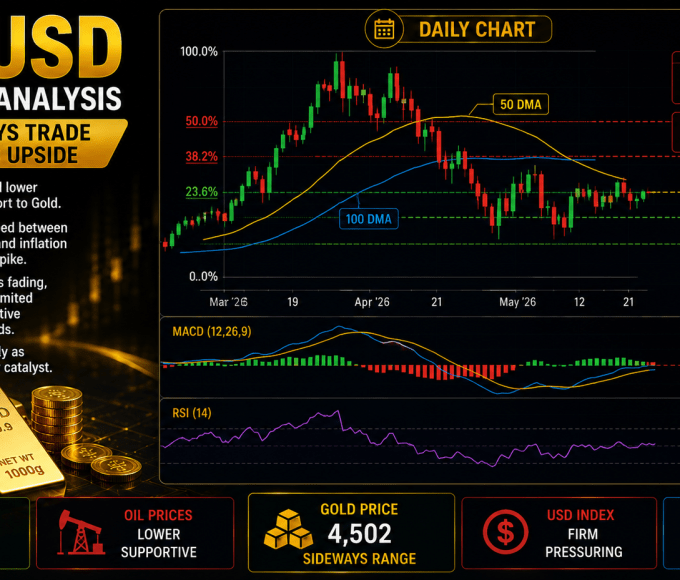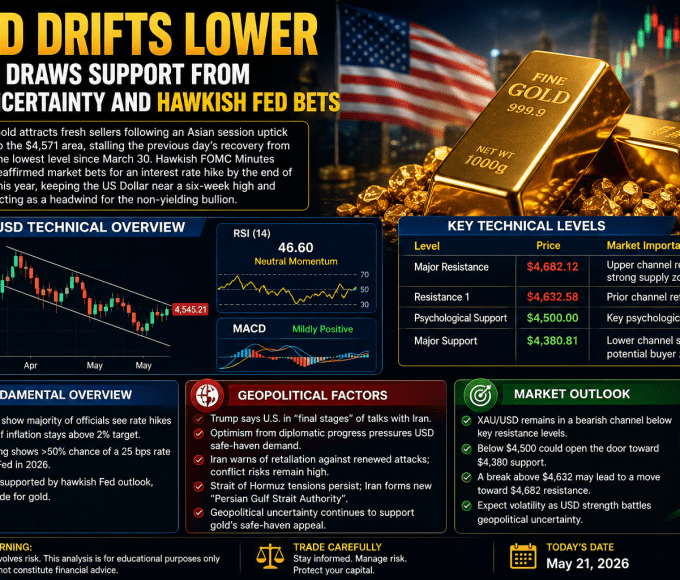
Gold prices remained highly volatile throughout the latest trading sessions as XAUUSD traded near the major psychological zone around $4,600. The yellow metal faced heavy pressure after stronger US inflation data boosted Treasury yields and strengthened the US Dollar across global financial markets. However, ongoing geopolitical tensions and persistent institutional demand continued preventing a complete bearish collapse, keeping gold trapped inside a powerful battle between buyers and sellers.
The biggest driver behind the recent gold volatility was the latest inflation data released from the United States. Consumer inflation remained significantly elevated, while producer-level inflation also accelerated more than market expectations. This immediately triggered aggressive repricing across financial markets as traders reduced expectations for near-term Federal Reserve rate cuts. Investors are now increasingly expecting the Federal Reserve to maintain higher interest rates for a longer period in order to control inflationary pressure inside the US economy.
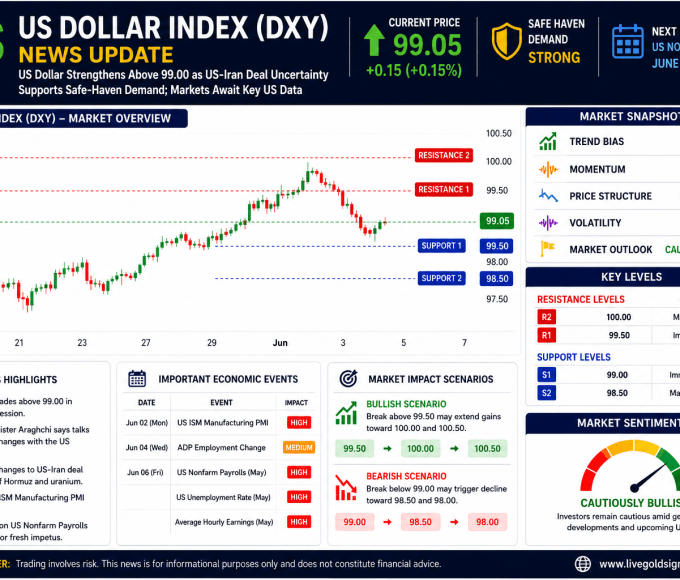
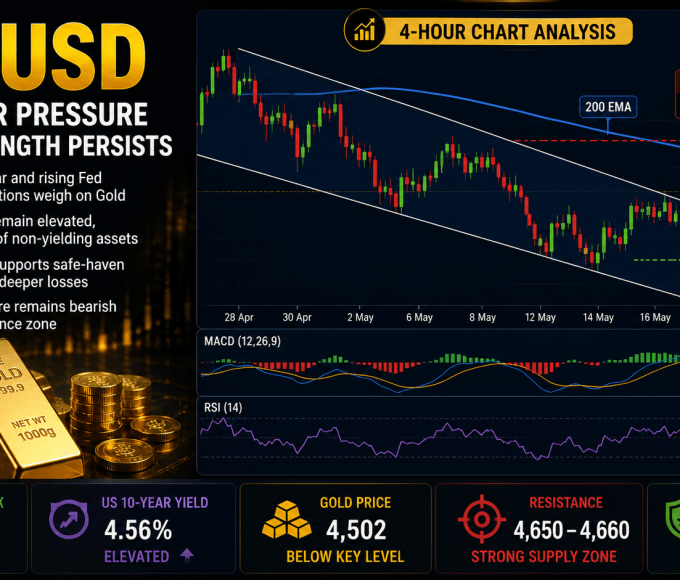
As a direct result of this shift in expectations, the US Dollar strengthened sharply while Treasury yields climbed toward fresh yearly highs. The 10-year and 30-year Treasury yields both surged aggressively during the week, creating heavy bearish pressure for gold prices. Since gold does not provide yield or interest returns, rising bond yields often reduce investor appetite for precious metals and increase demand for interest-generating assets.
Despite the bearish macroeconomic environment, gold continued finding support from rising geopolitical uncertainty. The ongoing conflict involving the United States and Iran remains one of the largest global concerns currently affecting commodity markets. Energy traders remain highly focused on developments surrounding the Strait of Hormuz because any disruption to global oil supply routes could significantly increase worldwide inflation pressure. Oil prices continued fluctuating sharply throughout the week, reinforcing concerns that inflation may remain elevated for longer than central banks previously expected.
Interestingly, the relationship between geopolitical risk and gold has become increasingly complex during recent weeks. Normally, escalating global tensions strongly benefit safe-haven assets like gold. However, the current situation is creating two opposing forces simultaneously. On one side, geopolitical instability increases demand for safe-haven assets. On the other side, higher energy prices caused by geopolitical conflict are strengthening inflation expectations, Treasury yields, and the US Dollar — all of which create bearish pressure on gold prices. This conflict between safe-haven demand and rising yields is one of the primary reasons behind the extreme volatility currently visible across the gold market.
Institutional Demand Still Supporting Gold
Although gold has experienced sharp corrections recently, institutional demand remains structurally strong. Central banks across multiple countries continue increasing gold reserves as part of long-term diversification strategies away from traditional reserve assets. Large institutional investors also continue viewing gold as an important hedge against long-term inflation risk, geopolitical uncertainty, and currency devaluation.
This institutional accumulation is one of the major reasons why gold continues finding strong buying pressure during deep corrections. Every aggressive selloff toward major support zones has recently attracted fresh buying interest from larger market participants, preventing a sustained bearish breakdown below long-term structural support levels.
Market Sentiment Remains Divided
Market sentiment surrounding gold currently remains extremely divided. Some traders believe that higher Treasury yields and persistent dollar strength could continue pressuring XAUUSD lower in the short term. Others argue that long-term inflation risks, geopolitical instability, and institutional demand will eventually support another bullish expansion phase for gold prices.
This division in market sentiment is creating highly unstable intraday price action. Gold repeatedly experiences strong rallies followed by aggressive selloffs within short periods of time. Liquidity sweeps and stop-hunting behavior have become increasingly common across lower timeframes, making trading conditions extremely challenging for short-term traders.
Technical Market Reaction
From a technical perspective, gold recently failed to maintain bullish momentum above the major resistance region near $4,750. This rejection triggered a strong corrective move lower, pushing XAUUSD back toward the critical support zones around $4,600. Sellers currently maintain short-term control below the upper resistance cluster, but buyers continue aggressively defending lower support regions.
The market is now trading inside an important consolidation structure where both bullish recovery and bearish continuation remain possible. If buyers successfully defend the current support region and Treasury yields begin stabilizing, gold could attempt another recovery toward higher resistance zones. However, continued dollar strength and rising yields may expose XAUUSD to deeper correctional pressure during the coming sessions.
Important Levels Traders Are Watching
| Level | Price | Market Importance |
| Major Resistance | $4,750 | Strong selling pressure zone |
| Current Price Zone | $4,600 — $4,620 | High volatility consolidation area |
| Major Structural Support | $4,557 | Institutional defense zone |
| Long-Term Support | $4,494 | Critical long-term support floor |
Outlook for Next Week
The upcoming trading week is expected to remain highly volatile for gold traders. Markets will continue monitoring inflation expectations, Federal Reserve commentary, Treasury yield movement, geopolitical headlines, and overall risk sentiment across global financial markets. Any signs of weakening inflation or falling yields could quickly support a bullish recovery in gold prices. However, if the US Dollar and Treasury yields continue strengthening aggressively, XAUUSD may remain under corrective pressure in the near term.
Overall, gold remains trapped between strong institutional long-term demand and short-term macroeconomic bearish pressure. This ongoing battle is creating rapid price swings and unstable market conditions, making disciplined risk management extremely important for traders during the coming sessions.
Risk Warning: Trading gold carries significant risk. Educational purposes only. Not financial advice.