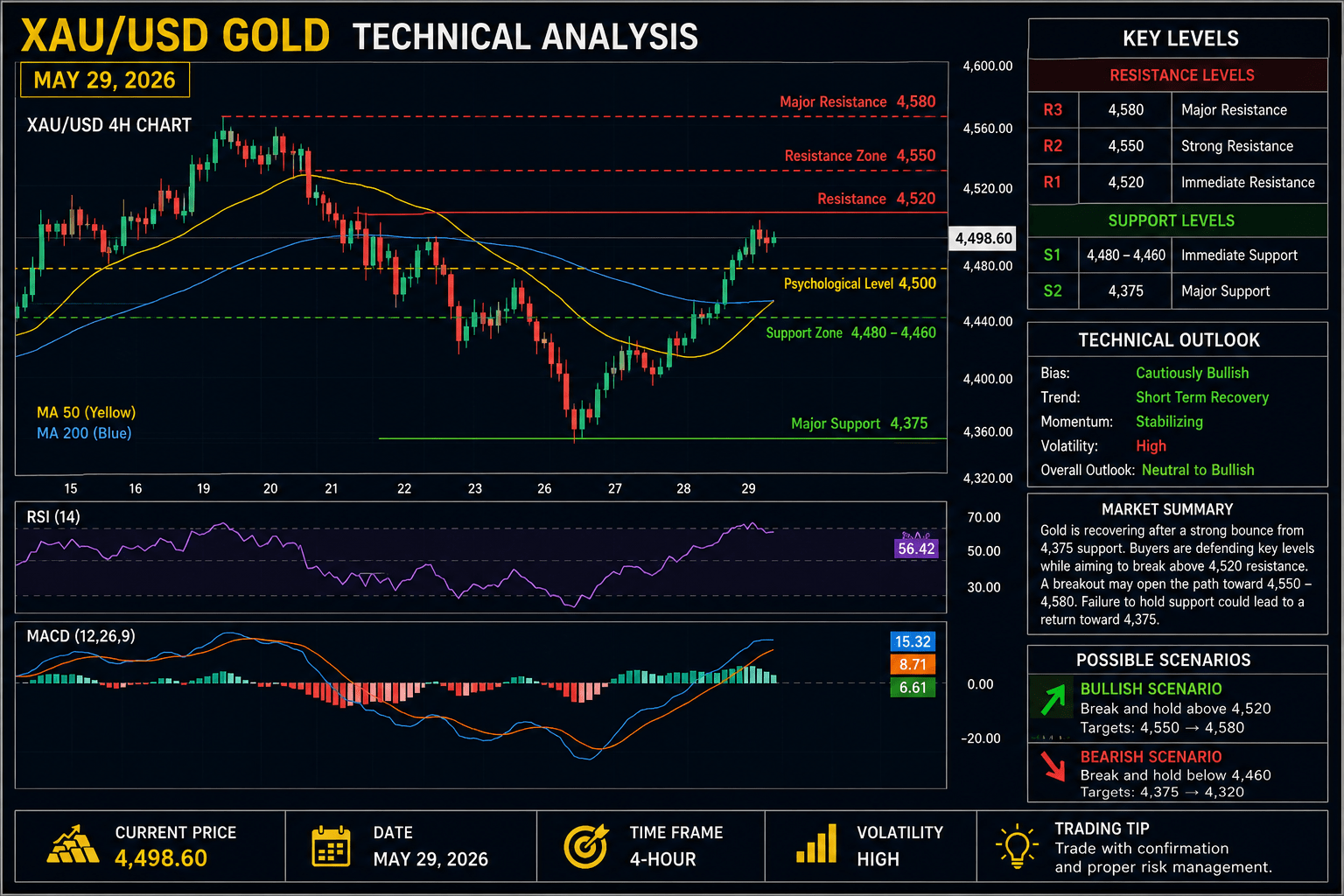
Gold prices are currently attempting to stabilize after facing aggressive bearish pressure during the previous trading sessions. The market recently rebounded strongly from the major support region near 4,375, allowing buyers to regain short term momentum and push prices back toward the 4,500 psychological area. This recovery movement has become an important focus for traders because the market is now positioned between strong resistance overhead and critical support below.
The recent price action suggests that bearish momentum has weakened compared to earlier sessions, though the broader short term structure still remains under pressure. Gold continues reacting sharply to movements in the US Dollar, Treasury yields, inflation expectations, and global risk sentiment. Because of these factors, volatility remains elevated and traders should expect continued two way price movement throughout the trading session.
From a technical perspective, the current market structure reflects a corrective recovery inside a broader bearish trend. Buyers are attempting to rebuild confidence after the recent selloff, while sellers continue defending major resistance zones. The next major directional move will likely depend on whether gold can maintain stability above immediate support and successfully break above overhead resistance levels.
Current Market Structure
The current market structure on lower timeframes shows that gold formed a strong swing low around the 4,375 area before beginning its recovery phase. This support zone attracted aggressive buying pressure, which helped the market reverse sharply upward after the recent decline.
Price action has now started creating higher lows, indicating improving bullish momentum in the short term. However, the broader structure still carries bearish characteristics because gold remains below several important resistance zones created during the previous selloff.
The recovery movement itself appears technically healthy because price is advancing gradually instead of creating unstable vertical spikes. Controlled bullish movement generally suggests stronger buyer participation and better momentum sustainability.
Despite the recovery attempt, traders should remain cautious because resistance levels above current price continue acting as major supply zones. A failure near resistance may quickly reactivate bearish pressure and return the market toward lower support levels again.
Support And Resistance Analysis
| Level Type | Price Zone | Technical Importance |
|---|---|---|
| Immediate Resistance | 4,520 | Short term breakout level |
| Major Resistance | 4,550 – 4,580 | Strong supply zone |
| Psychological Level | 4,500 | Market sentiment zone |
| Immediate Support | 4,480 – 4,460 | Intraday buyer support |
| Major Support | 4,375 | Primary swing support |
The support region around 4,480 to 4,460 currently remains the most important short term defensive area for buyers. As long as gold remains above this region, the recovery structure may continue developing.
On the upside, the first important resistance remains near 4,520. This level may determine whether buyers can continue strengthening momentum or whether sellers regain control again.
A confirmed breakout above 4,520 could trigger stronger bullish continuation toward the larger resistance zone between 4,550 and 4,580. However, failure near resistance could quickly increase bearish pressure once again.
Trend Direction Analysis
The short term trend currently appears cautiously bullish because the market is forming higher lows after rebounding from the recent swing bottom. Buyers have successfully reduced immediate downside pressure and improved momentum across lower timeframes.
However, the broader intraday structure still remains partially bearish because price has not yet broken above the major resistance cluster around 4,550 and 4,580. Until this breakout occurs, the current recovery may still be considered corrective rather than a full bullish trend reversal.
The recent bearish wave was extremely aggressive, creating strong downside momentum across the market. Because of this, sellers may still attempt another bearish continuation if recovery momentum weakens near resistance levels.
Traders should therefore monitor price action carefully around key breakout zones before expecting stronger directional continuation.
Moving Average Analysis
Gold is currently attempting to recover toward short term moving average zones after trading below them during the recent bearish decline. These moving averages may now act as dynamic resistance levels during the recovery process.
If price successfully stabilizes above short term moving averages, bullish confidence may gradually improve among intraday traders. This could support additional upside continuation toward higher resistance zones.
At the same time, medium term moving averages still remain tilted downward, which reflects ongoing pressure within the broader structure. This means the market has not yet fully transitioned into a bullish environment.
A strong bullish breakout above multiple moving average zones would significantly improve the technical outlook and may attract stronger buying participation from momentum traders.
Momentum Indicator Analysis
Momentum indicators are currently showing early signs of stabilization after remaining heavily oversold during the previous sessions. The recent recovery movement helped reduce immediate bearish pressure and improved overall market balance.
The Relative Strength Index is gradually recovering from lower levels, suggesting that bearish momentum has slowed significantly. However, RSI still requires stronger continuation before confirming a fully bullish structure.
MACD momentum also indicates that sellers are losing short term dominance compared to earlier sessions. The recovery in momentum supports the possibility of continued upward correction while support zones remain intact.
Despite improving momentum conditions, traders should still wait for stronger confirmation above major resistance before expecting larger bullish continuation.
Price Action Behavior
Recent candlestick formations indicate increasing buyer participation near support levels. Strong rejection candles around the 4,375 region confirmed that buyers were actively defending the market after the sharp selloff.
The formation of higher lows during the recovery phase also strengthens the current bullish correction scenario. Buyers are gradually regaining confidence, though resistance zones continue limiting momentum expansion.
Price action near 4,520 and 4,550 will remain critical because these zones may determine the next major market direction. A successful breakout could trigger stronger bullish continuation, while rejection may quickly return bearish momentum.
Intraday candles currently suggest improving stability, though volatility remains high and false breakouts may still occur frequently.
Bullish Technical Scenario
The bullish scenario remains active while gold trades above the immediate support region near 4,480. Buyers currently appear committed to defending lower support levels and rebuilding momentum.
If price successfully breaks above 4,520 resistance, bullish momentum could strengthen significantly. In such a scenario, gold may continue moving toward 4,550 and eventually challenge the 4,580 resistance zone.
A strong breakout above 4,580 would become an important bullish technical signal because it could invalidate portions of the previous bearish structure and encourage additional buying activity.
Bullish continuation may also receive support if the US Dollar weakens or if global uncertainty increases safe haven demand for gold.
Bearish Technical Scenario
Although the market is recovering, bearish risks remain active because the broader structure has not fully turned bullish. Sellers may attempt another downside move if resistance zones continue holding firmly.
A rejection from 4,520 or 4,550 could become an early warning signal for renewed bearish continuation. Lower highs near resistance would indicate weakening buyer strength.
A breakdown below 4,460 support could quickly expose gold toward the major swing support near 4,375. If this level fails, bearish momentum may accelerate aggressively during upcoming sessions.
Stronger US economic data, rising bond yields, or renewed Dollar strength could further increase downside pressure on gold prices.
Technical Outlook Summary Table
| Technical Factor | Current Bias | Market Signal |
|---|---|---|
| Short Term Trend | Cautiously Bullish | Recovery above support |
| Momentum Indicators | Stabilizing | Bearish pressure slowing |
| Resistance Structure | Strong | Selling pressure active |
| Support Structure | Stable | Buyers defending lows |
| Volatility Conditions | High | Sharp intraday swings |
Intraday Trading Conditions
Current intraday trading conditions remain highly volatile as gold continues reacting to macroeconomic developments and technical momentum shifts. Traders may find opportunities on both sides of the market depending on price reaction near key levels.
Buying near strong support with proper confirmation may currently provide better risk to reward opportunities compared to chasing price near resistance levels.
At the same time, aggressive selling without confirmation may also become risky because buyers are actively defending lower support zones.
Because volatility remains elevated, traders should avoid emotional decision making and focus on disciplined risk management strategies.
Final Technical Outlook
Overall, gold is currently attempting to stabilize after defending the major support zone near 4,375. Buyers are gradually rebuilding momentum while the market trades above immediate support levels.
The short term technical outlook remains cautiously bullish as long as gold continues holding above 4,480 support. A successful breakout above 4,520 may strengthen bullish continuation toward 4,550 and 4,580.
However, failure to maintain support could quickly reactivate bearish pressure and expose the market toward previous lows once again.
Under current market conditions, traders should continue monitoring resistance behavior, US Dollar movement, Treasury yields, and global economic sentiment because these factors remain critical for determining gold’s next major direction.